

During perimenopause, falling oestrogen has real, measurable effects on your bones, your muscle, and your heart health. Understanding why strength training and movement matter through this shift can help you make informed choices about how you move.
Why strength training and exercise in perimenopause matter for your bones
Oestrogen helps keep your bones strong. As your levels drop through perimenopause and into menopause, bone density falls, and that can raise your risk of osteoporosis, a condition that weakens bones and makes them more likely to break. The years around menopause are when bone density can drop most, which makes this a useful window to act.1
Your bones stay strong when you give them work to do. A mix of weight-bearing exercise with impact, such as jogging, and muscle-strengthening work through resistance training helps your bone health. Progressive resistance training, where you gradually add weight over time, tends to be the most effective kind of muscle-strengthening exercise for your bones.2
Weight-bearing exercise can protect your bone strength. That includes gentler options such as walking and stair-climbing, which give you an accessible place to start if heavier resistance training feels like too much right now.3
Holding on to muscle mass as oestrogen declines
If keeping your muscle feels harder than it used to, falling oestrogen is part of the picture. As levels drop, muscle mass and strength tend to decrease too. This can speed up around menopause, so the muscle you have may take more deliberate effort to hold on to.5
Strength exercise is the most effective way to build new muscle. Building and keeping muscle raises your metabolic rate, the speed at which your body uses energy. As oestrogen drops, muscle can decline and your metabolism may slow, and that can feed into changes in your weight and body composition.6
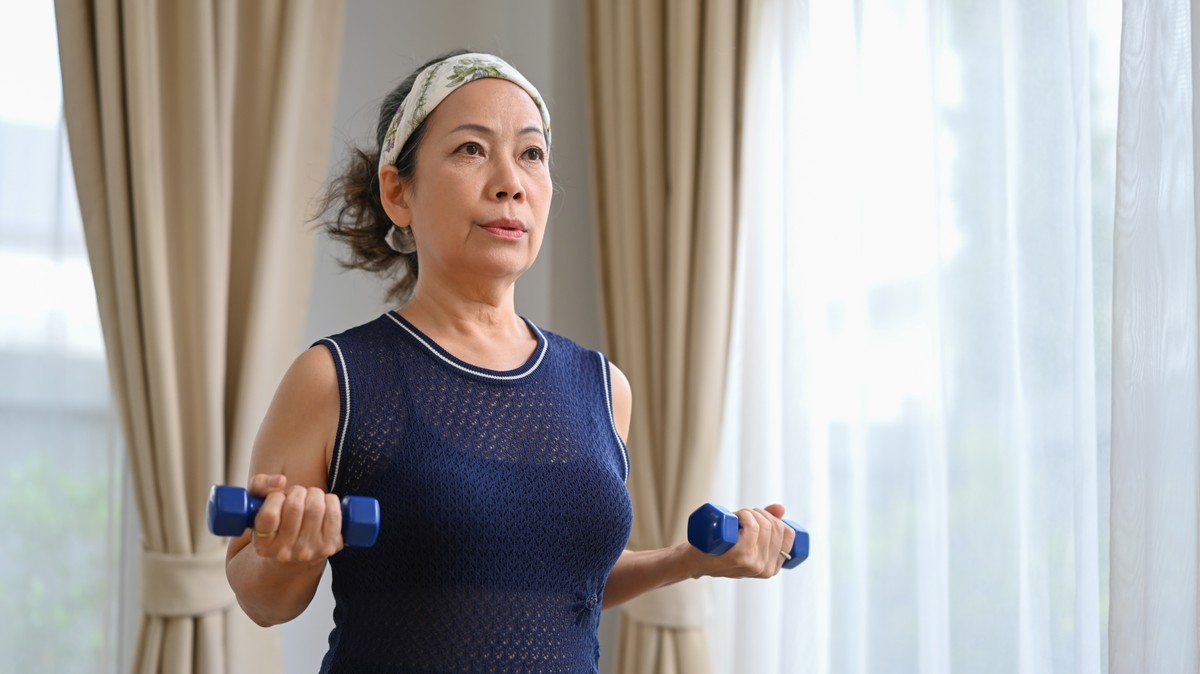
Strengthening activities that work all your major muscle groups on at least two days a week are the general guidance. Lifting weights, using resistance bands, and bodyweight moves such as squats and press-ups all count. You do not need a gym to get started.7
How exercise supports your heart health?
Your risk of heart disease climbs during menopause, partly because you lose the oestrogen that helps protect it. As those levels fall, your heart and blood vessels become more vulnerable.8
Regular exercise supports your heart by helping to keep your blood pressure and cholesterol in a healthy range. Aiming for at least 150 minutes of moderate-intensity activity a week is the standard guidance for heart benefit. Aerobic activities such as brisk walking and swimming feed directly into your fitness.9
Stopping smoking, eating well, and keeping up regular exercise are key lifestyle steps for lowering your risk of coronary heart disease, the narrowing of the arteries that supply your heart. Strength training sits within this picture. Combining cardiovascular exercise with resistance work gives your heart, your muscles, and your bones the strongest support.10
Putting it all together
The three areas here, your bones, your muscle, and your heart, all respond to exercise in overlapping ways. A routine with weight-bearing activity, progressive resistance training, and regular moderate-intensity movement covers all three. What matters most is staying consistent over time rather than going hard in any single session.