
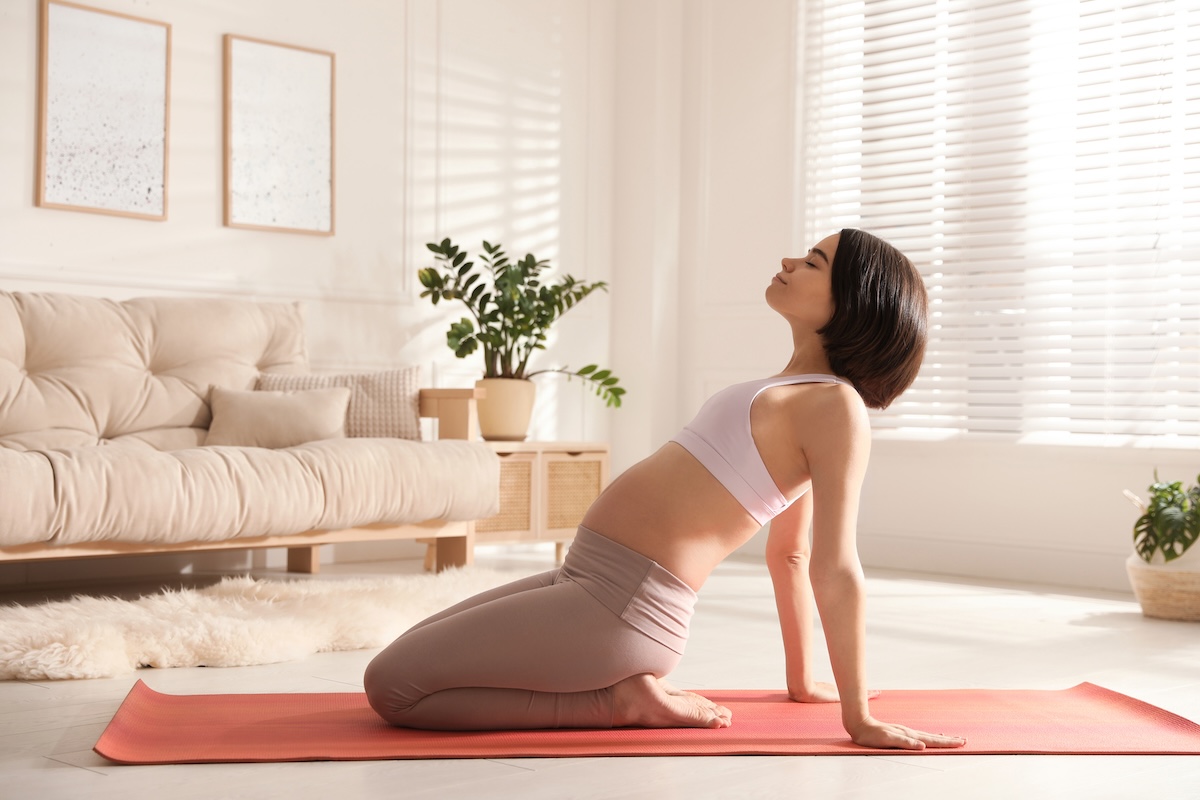
Exercise in the first trimester of pregnancy can feel like a guessing game on top of everything else. You may have had a routine that worked before, and now even thinking about it takes effort. These early weeks are often the hardest point to know what to do with when it comes to movement, and that uncertainty is worth talking through.1
What safe exercise in the first trimester looks like in practice
If your pregnancy is uncomplicated, the general guidance is to aim for at least 150 minutes of moderate activity a week. Breaking it into shorter blocks, a 20-minute walk here, a gentle swim there, works just as well, and it is often more realistic when your energy is hard to predict.2
The clearest principle for these early weeks is to carry on with what you were already doing, at a comfortable level. Keeping movement steady at a manageable pace is the aim. Low-impact options like brisk walking, swimming, stationary cycling, and prenatal yoga can feel better when navigating sickness and nausea. If you go for prenatal yoga, look for a class led by an instructor with specific pregnancy experience.3
Reading the signals your body sends during exercise
A simple way to check your intensity is the talk test. If you can hold a conversation while you are moving, you are likely at a moderate, comfortable level. If you are too breathless to get a sentence out, you are probably working too hard. If breathlessness comes on suddenly or feels severe, speak to your midwife or GP. As a day-to-day guide, though, it is reliable and asks nothing of you beyond paying attention.4
Pelvic floor awareness from the start
Your pelvic floor is a group of muscles at the base of the pelvis that hold up your bladder, bowel, and uterus. As pregnancy goes on, these muscles carry more load, and starting pelvic floor exercises early gives them the best chance of coping well. Beginning in the first trimester helps with bladder control through pregnancy and makes recovery after birth more straightforward.5
If you already feel pelvic pain, a sense of heaviness or pressure in the pelvis, or any signs of prolapse, it can be helpful to speak to a to a women's health physiotherapist for support with symptoms and to ensure you are doing your exercises correctly. Symptoms like these can mean a standard approach needs adapting for you.
Nausea, fatigue, and what is realistic
Nausea and fatigue are common in the first trimester, and they shape what feels possible on any given day. On days when nausea is strong, a short walk may be all that fits. On days when your energy stretches a little further, gentle movement at a comfortable pace is a reasonable aim. It helps to follow what your body is telling you.
Sometimes nausea and fatigue in early pregnancy point to something that needs looking into. If either feels severe, or comes with other symptoms, raise it with your midwife or GP rather than assuming it is just part of the picture.
What to reduce and what to avoid
Some activities carry risks in pregnancy that outweigh what they offer. Contact sports like judo, activities with a real risk of falling like horse riding or skiing, scuba diving, and exercise at high altitude are best avoided. With contact sports and high-fall activities, the worry is impact or injury to your abdomen. Scuba diving brings risks from pressure changes that cannot be safely managed in pregnancy.7
More broadly, the first trimester is a good point to ease the intensity, shorten your sessions, and lean towards lower-impact options. These are practical responses to what your body is handling during these weeks, and they are easy to revisit as things change.
Signs to stop and seek help
Stop exercising and call your midwife or GP if you notice dizziness, headaches, fluid leaking, vaginal bleeding, or painful contractions. For more acute symptoms like chest pain or heavy bleeding, call 999 or contact your maternity triage unit straight away. Both need prompt attention.6
Your midwife appointment is a good chance to talk through how active you are now and whether anything needs adjusting for your pregnancy. If you have not raised exercise at an antenatal appointment yet, it is worth doing at your next one.