
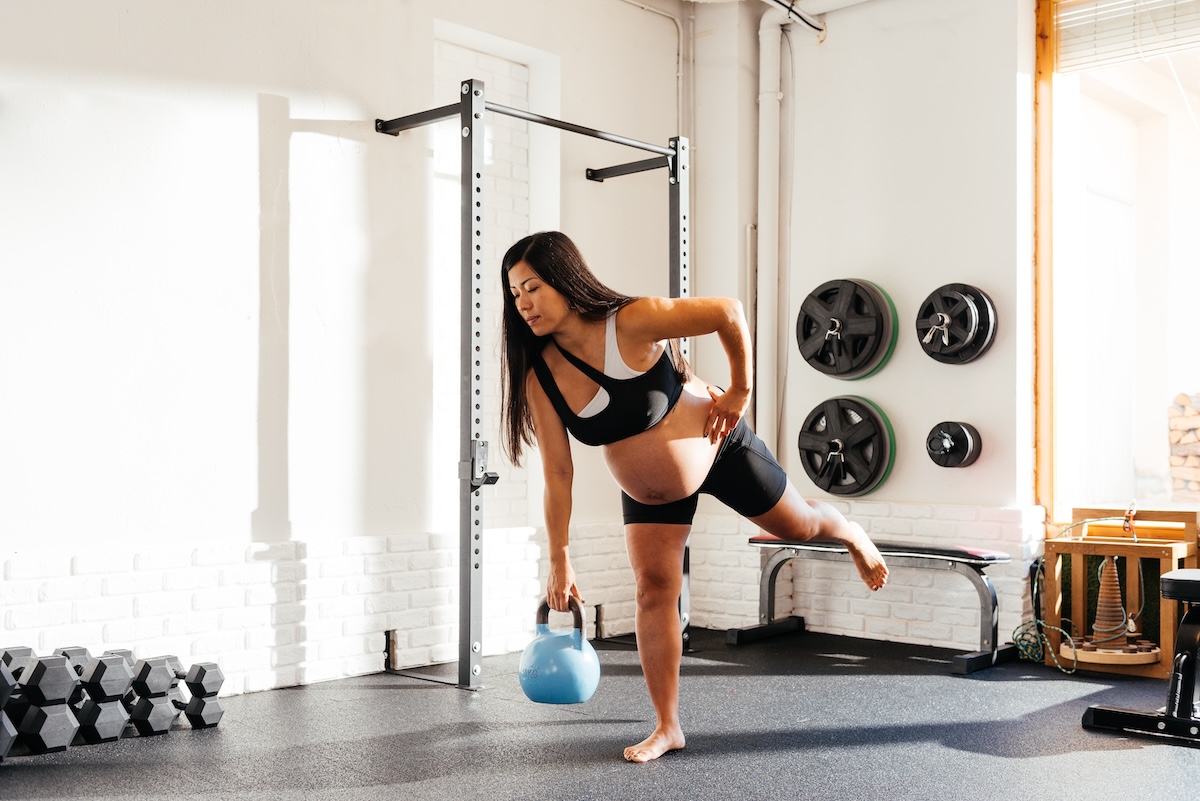
If you were running intervals, lifting heavy, or getting through HIIT sessions before pregnancy, working out what you are meant to do now can feel genuinely unclear. The breathlessness you used to push through, the core work you relied on, the weights you loaded without thinking, all of it suddenly comes with a question mark. A lot of the guidance out there is aimed at people who were not exercising much to begin with, and it does not always speak to where you are starting from. High intensity exercise in pregnancy is not a simple topic, and the honest answer is that it depends on your body, your pregnancy, and how things feel as you go.
The first thing worth knowing is that if you were regularly active before pregnancy, staying active is generally safe and good for you. The aim shifts, though. During pregnancy, the goal is to hold on to the fitness you have built rather than push harder or chase progress. Slowing down as pregnancy goes on is normal and expected.1
General guidance in the UK suggests around 150 minutes of moderate intensity a week during pregnancy. If you were doing vigorous exercise before, you can usually carry on at that level, as long as you are healthy and have no reasons not to. It is worth talking this through with your midwife or GP before you make decisions about your training. The advice you get should fit you specifically, so your healthcare team should ask about your existing habits and shape their guidance around your situation.2
What breathlessness tells you
One of the most reliable ways to gauge intensity during pregnancy is the talk test. If you can hold a conversation while you exercise, your intensity is probably fine. If you are too breathless to speak in full sentences, that is your cue to bring things down. Heart rate targets are less useful now because your heart and circulation change a lot during pregnancy, so the talk test gives you a more practical check in the moment.3
Some breathlessness when you are working hard is normal. What is worth noticing is breathlessness that feels out of step with what you are doing, or that does not settle when you ease off. Chest pain, heart palpitations, or breathlessness that feels alarming are reasons to stop and get medical advice quickly.4
Pelvic floor signals during exercise
As your baby grows, your pelvic floor muscles take on more load. One common result is leaking urine, known as stress incontinence, during things like jumping, running, lifting, coughing, or sneezing. If this is happening to you, it is worth paying attention to. The activity is asking more of your pelvic floor than it can comfortably handle right now.5
Beyond leaking, notice any feeling of heaviness, pressure, or a sense of bulging in the vaginal area during or after exercise. These sensations can mean your pelvic floor is under more strain than that activity should be putting on it, and they are a reason to stop and adjust what you are doing. If these feelings stick around, raise them with your midwife, GP, or a women's health physiotherapist.6
Pelvic floor exercises throughout pregnancy can help. Squeezing and lifting your pelvic floor before anything that raises pressure in your abdomen, like lifting a weight or carrying a bag, is a practical way to manage that load.7
Abdominal doming and what it means
Doming, sometimes called coning, is a visible ridge or bulge that can show up down the centre of your stomach when you are working hard. You might notice it during a sit-up, a plank hold, or a heavy lift. It happens when the pressure inside your abdomen pushes against the connective tissue running down your midline, the linea alba, which stretches and softens during pregnancy.8
Doming can be linked to Diastasis Rectus Abdominis (DRA), the natural change to the rectus abdominus muscles and connective tissue between them that happens as your uterus grows. This is a normal part of how pregnancy works. Doming during exercise is still a useful signal, though. It tells you the movement is creating more internal pressure than your abdominal wall is handling well in that position.9
If you notice doming, the practical response is to adjust rather than stop. Try changing your position, easing off the load, or breathing out through the hardest part of the movement. Exhaling as you push helps manage the build-up of pressure. If you are not sure whether what you are seeing is doming, or you have concerns about abdominal separation, a women's health physiotherapist can assess you.10
How your pre-pregnancy fitness shapes what is appropriate
Your fitness history matters. If you have been running regularly or training hard for years, your body is already adapted to those demands, and pregnancy does not undo that. What it does is change the context. Your joints move more freely because of hormonal changes (relaxin loosens your ligaments), your centre of gravity shifts as your bump grows, and your heart is working harder even at rest. These changes affect your balance and joint stability, so the risk of falls and injury from certain activities goes up as pregnancy progresses.11
Some activities are worth avoiding whatever your fitness level, because they carry a high risk of falling, a blow to the abdomen, or collision. Contact sports, horse riding, skiing, and certain racquet sports fall into this group. The risks come from an uneven surface, an unpredictable opponent, or a fall.12
What adapting your training looks like in practice
If running is part of your training, you can usually keep going if you were running before pregnancy and it still feels comfortable. As your bump grows and your body changes, you may find you need to slow your pace, shorten your distances, or switch to walking or swimming when running stops feeling manageable. That is the normal arc of pregnancy training.13
For strength work, the idea is to reduce load rather than give up lifting entirely. Lighter weights or bodyweight work well. The aim is to keep moving in a way your body can handle without setting off the signals above.14
There is no single rule that fits every pregnancy or every body. The signals you get during and after exercise tell you more than any fixed plan. If something causes leaking, pressure, pain, doming, or unusual breathlessness, that is information to act on. You can modify the movement, ease off the intensity, or rest.