

You may have noticed the familiar discomfort feels markedly heavier in the days before your period, and the cramping that comes with menstruation can be hard to separate from gut pain. The link between your cycle hormones and these digestive symptoms is real, and it has a physical basis in the way your gut responds to hormonal change. Irritable bowel syndrome (IBS) tends to follow the rhythm of your cycle more closely than it might seem.
How your cycle hormones shape your digestive system
Your gut carries receptors for oestrogen and progesterone, so it responds directly to the way these hormones rise and fall across your cycle. As their levels shift, so can the speed things move through your gut, how sensitive it feels, and how much inflammation it carries through the month.3
How this feels depends on where you are in your cycle. In the luteal phase, the stretch between ovulation and your period, progesterone takes over. It relaxes the smooth muscle of your intestine and slows things down, which can leave you sluggish, bloated, or constipated in the days before you bleed. Oestrogen tends to speed digestion up instead. When both hormones drop sharply as your period starts, your gut can swing the other way.1
Why your period itself can bring the hardest gut days
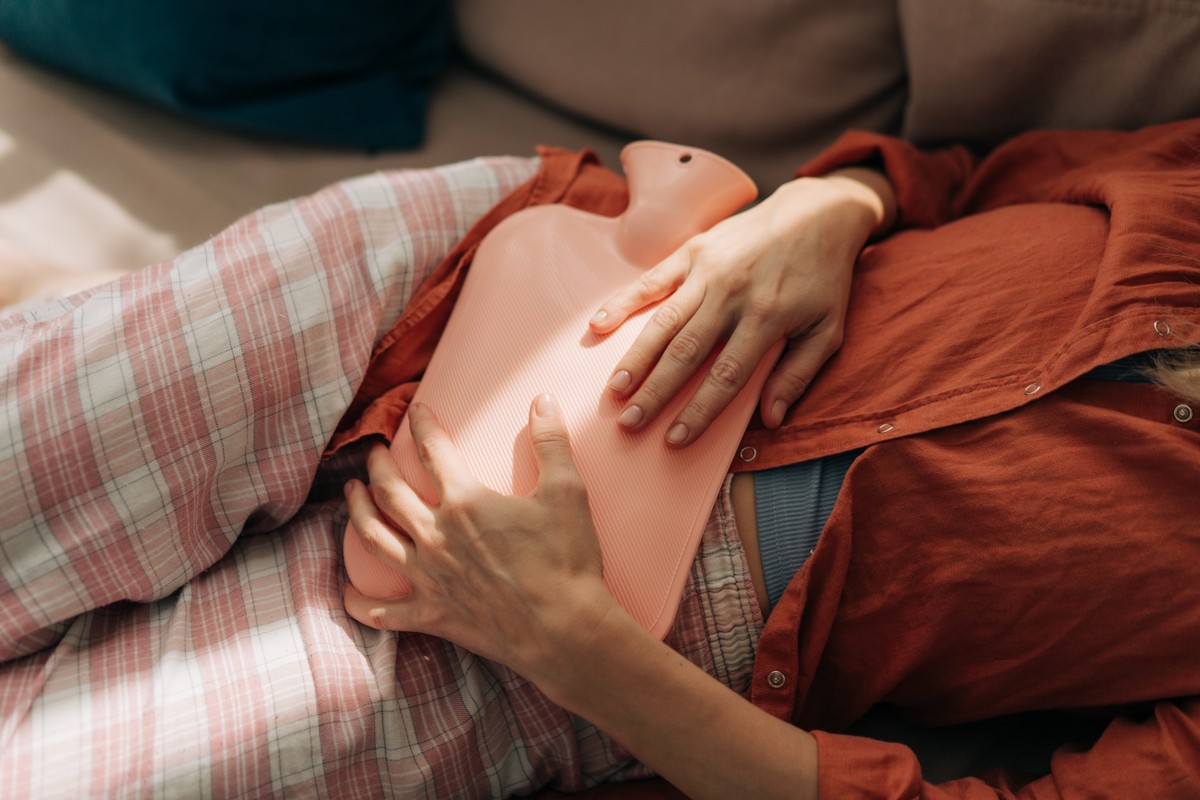
When your period starts, the cramping and the loose stools or diarrhoea often arrive together, and prostaglandins are a big part of why. These are natural compounds your body releases to help the uterus contract and shed its lining. They also act on the muscles of your intestines, making them contract too, so your gut feels it alongside your uterus.4
On top of that, the hormone drop just before and during your period can lower your pain threshold. The bloating or internal pressure you would barely notice mid-cycle can feel much sharper in the days around your period. This is sometimes called visceral hypersensitivity, where your gut reacts more strongly to pain signals than usual.2
Finding your own food triggers
There is no single list of foods that flares IBS for everyone. What sets off symptoms for you might do nothing to someone else. Keeping a food and symptom diary is a practical way to spot your own patterns. If you note what you eat and drink, along with any symptoms that follow, over several weeks, over time, patterns across your cycle may start to show.5
How meal timing and size can help
How often and how much you eat can matter as much as what is on the plate. Smaller, more regular meals across the day, rather than two or three large ones, may keep symptoms easier to handle. Large or high-fat meals can over-stimulate your gut and bring a stronger reaction, which is worth keeping in mind through the luteal and menstrual phases, when your gut is already more reactive.7
The emerging link between ADHD and your gut
If you have ADHD, you may be more likely to live with IBS too. There is a real association between attention deficit hyperactivity disorder (ADHD) and IBS. The link runs through the gut-brain axis, the two-way line of communication between your digestive system and your brain. This is still an area of active research rather than settled guidance.8
A few things that often come with ADHD may feed into gut sensitivity and IBS flare-ups. A more reactive stress response, harder-to-manage emotions, and irregular eating, like skipping meals during a stretch of hyperfocus, can all play a part. This is background rather than a diagnosis. If you have ADHD and your gut symptoms are significant, raise it with your GP, who can look at both together.9